
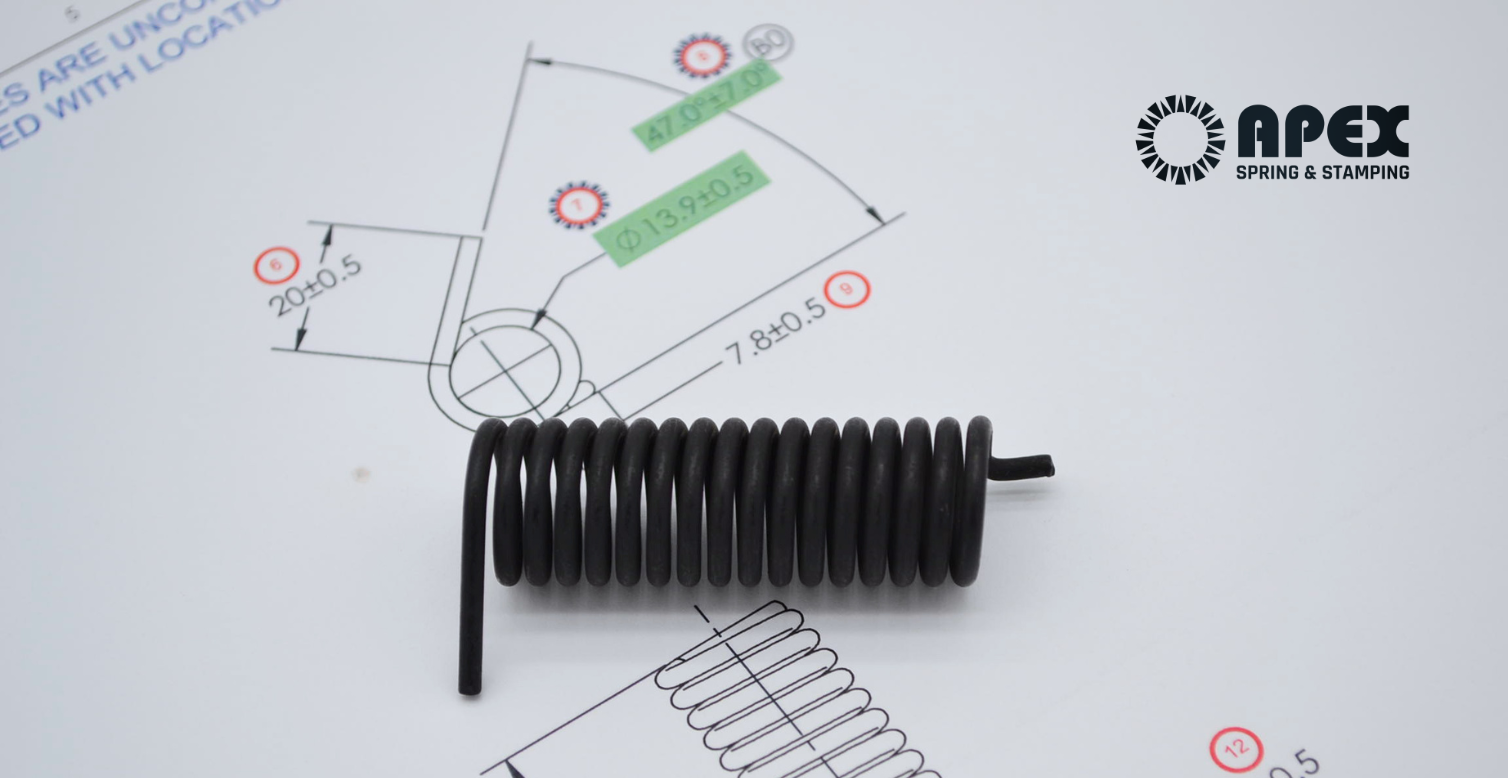
In spring manufacturing, success is often measured in thousandths of an inch. For purchasing agents and engineers, understanding spring tolerances isn’t just a technical detail—it’s a critical factor that directly impacts product performance, reliability, and long-term cost.
This 2-part blog series will break down why tolerances matter, how they affect different spring types, and what to look for when selecting a manufacturing partner.
What is it and Why Does it Matter?
Whether you’re sourcing compression, extension, or torsion springs, consistent tolerances ensure that every component performs exactly as intended. Deviation can lead to inconsistent force output, premature wear, or complete system failure. But there is so much to consider when determining tolerance for any design. Let’s start with the basics.
What Are Spring Tolerances?
Spring tolerances refer to the allowable variation in a spring’s physical and mechanical characteristics. These include:
- Wire diameter
- Outside or inside diameter
- Free length
- Pitch (spacing between coils)
- Spring rate (force per unit of deflection)
- Load at a given height or angle
No manufacturing process can produce perfectly identical parts every time. Therefore, tolerances define the acceptable range of variation.
Why Tolerances Matter
Consistent Performance
When springs are designed for use in assemblies, consistency is everything. If one spring delivers slightly more force than another, it can create uneven load distribution across components.
In high-volume production environments, even minor inconsistencies can result in:
- Misalignment in assemblies
- Uneven wear on mating parts
- Increased vibration or noise
Maintaining consistency in manufacturing will ensure each spring behaves predictably, enabling smoother assembly and better overall system performance. One way to achieve this consistency is by setting tolerance that is ideal for the application.
Reliable Load and Force Output
Springs are often specified based on the force they exert at a certain deflection. If tolerances are not set properly, the actual force output can vary.
For example:
- A compression spring designed to deliver 10 lbs. of force could vary enough to affect product function where it doesn’t function if it delivers 8 lbs. of force or less. Having a tolerance range to prevent that condition is necessary.
- In safety-critical applications, this variation could compromise performance or compliance. Having proper tolerance allows some variation but not enough to create a failure of the assembly which in turn could lead to injury.
Maintaining tolerance on spring rate and load ensures that:
- Mechanical systems function as designed
- Safety margins are preserved
- Product testing yields repeatable results
Fit and Function in Complex Assemblies
Modern manufacturing often involves tight packaging constraints, complicated assemblies, and more. Springs must fit precisely within housing, especially if they interact with other components. Precision in dimensions ensures seamless integration into your assembly.
Tolerance issues can lead to:
- Springs that are too long or too short
- Interference with surrounding parts
- Improper seating or alignment
For example:
- An oversized torsion spring may bind within its mounting points causing the spring not to sit into the position it was designed.
- An undersized extension spring may not maintain proper tension and could be overstretched causing failure
Precision in dimensions ensures seamless integration into your assembly.
Fatigue Life and Durability
Spring performance is also about how the spring performs over time.
Significant variations in material or geometry can create stress concentrations, leading to:
- Early fatigue failure
- Reduced cycle life
- Unexpected downtime
Tight tolerances help maintain uniform stress distribution throughout the spring, which is critical for:
- High-cycle applications
- Automotive and industrial systems
- Any product where longevity matters
Tolerances, continued…
It is clear that tolerances are essential for ensuring performance, reliability, and long-term durability. But the conversation doesn’t stop there. Come back for PART 2 of this series, where we will discuss tolerance considerations for each type of spring, and how those considerations affect cost and manufacturing.
Ready to start the conversation? Contact us today!
| Contact Us | Request A Quote |
Related

Manufacturing
10.08
5 Questions to Ask Before Choosing a Spring Manufacturer
5 Questions to Ask Before Choosing a Spring Manufacturer
Springs can have a significant impact on product performance, reliability, assembly, and ultimately your customer experience. Therefore, choosing the right manufacturing partner means finding a supplier that understands not only the technical aspects of the product, but also how the spring needs to perform in your application.

Manufacturing
09.10
Your Guide to Spring Material Selection
Your Guide to Spring Material Selection
Successful spring material selection begins with understanding the environment in which the spring will operate and the performance expectations it must meet. While music wire remains a cost-effective solution for many applications, stainless steel excels in corrosive environments, and chrome silicon delivers superior performance in high-stress applications. If you’re unsure which material is right for your application, the engineering team at Apex Spring & Stamping can help identify the best solution for your specific requirements.

Miscellaneous
08.20
FAQs About Custom Spring Quotes
FAQs About Custom Spring Quotes
Whether you have a production-ready drawing, an existing spring that needs to be reverse engineered or an early-stage design that still needs engineering, Apex Spring & Stamping can help you move from concept toward production.