
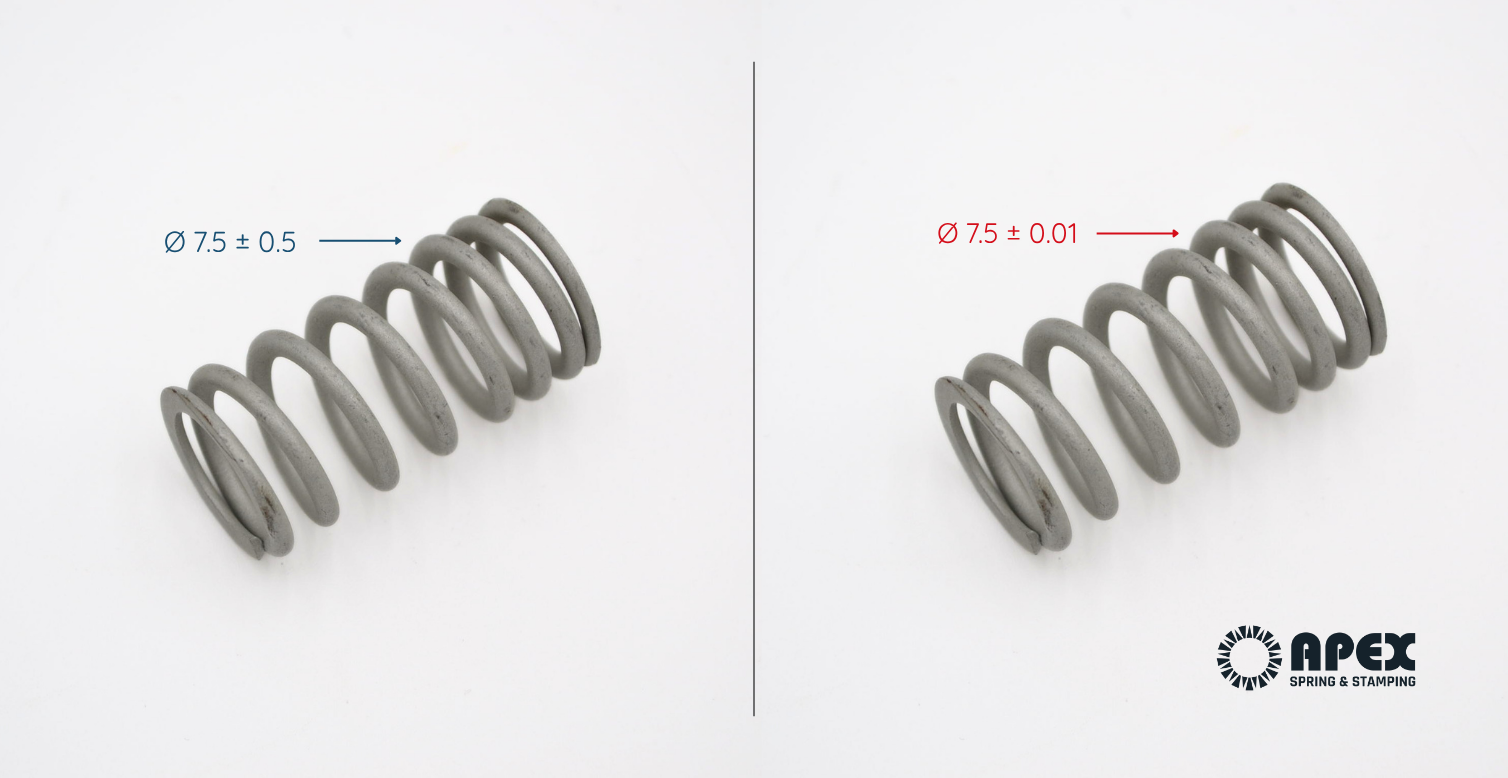
In part one of “Exploring Spring Tolerance,” we first defined spring tolerance and then began to explain why it matters in spring manufacturing. In part 2, we will discuss key tolerance considerations for each spring type, why it matters, and how these things affect manufacturing.
Considerations by Spring Type
Compression Springs
Compression springs are typically used to resist applied force and return to their original length.
Key tolerance factors:
- Free length
- Outside diameter
- Spring rate
Why it matters:
If free length varies too much, springs may not preload correctly, affecting force output. In applications like valves or suspension components, this can lead to inconsistent performance.
Extension Springs
Extension springs operate under tension and are designed to stretch when force is applied.
Key tolerance factors:
- Initial tension
- Hook/loop geometry
- Overall length
Why it matters:
Initial tension must be controlled to ensure proper operation. Too much variation can cause springs to engage too early or too late in a system, leading to functional issues.
Hook geometry is another critical area— inconsistencies can lead to weak points and premature failure.
Torsion Springs
Torsion springs store and release rotational energy, often used in hinges, clips, and mechanical linkages.
Key tolerance factors:
- Leg angle and position
- Torque output
- Coil diameter
- Coil body length
Why it matters:
Example: a deviation in leg angle can alter how force is applied within an assembly. This can impact motion control, alignment, and overall system efficiency.
Consistent torque output is essential for applications requiring precise rotational force.
The Cost of Tolerances
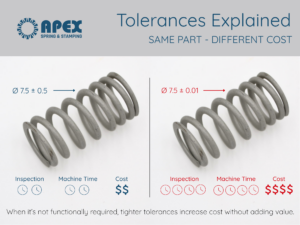
At first glance, tighter tolerances may seem nonnegotiable. But tolerances should be carefully considered, especially when balancing quality and cost effectiveness.
Consider the following…
Too loose of a tolerance can lead to:
- Difficulties during assembly
- Product returns or warranty claims
- Downtime due to component failure
Too tight of tolerance can lead to:
- Increased time on machines
- Additional quality checks
- Drive up tooling and production costs
- Overall, a longer, more labor intensive, and higher cost manufacturing process
Balancing Precision and Manufacturability
It’s important to consider a realistic tolerance for each part so that all your goals can be accomplished. Considerations like timeframe, budget, product testing, and more. The key is to specify tolerances that are tight enough to ensure the part can perform properly, but not tighter than required for the application.
In the production of any part of any component, ensuring consistent tolerances and high-quality output is always the goal. To help do this, Apex offers:
- Advanced forming and coiling equipment
- In-process inspection and quality control systems
- Material expertise and traceability
- Experience across multiple product types and applications
Equally important is collaboration. Our team engages early in the design process and can help refine tolerances to improve both performance and manufacturability.
Apex has the experience and expertise to help determine the optimal balance between performance and cost. A clear benefit to engineering and manufacturing operating under one roof!
Get Started Today!
When components perform exactly as expected, everything else works better. Apex understands this and is a perfect partner for your next project!
Contact us or Request a Quote today!
| Contact Us | Request A Quote |
Related

Manufacturing
10.08
5 Questions to Ask Before Choosing a Spring Manufacturer
5 Questions to Ask Before Choosing a Spring Manufacturer
Springs can have a significant impact on product performance, reliability, assembly, and ultimately your customer experience. Therefore, choosing the right manufacturing partner means finding a supplier that understands not only the technical aspects of the product, but also how the spring needs to perform in your application.

Manufacturing
09.10
Your Guide to Spring Material Selection
Your Guide to Spring Material Selection
Successful spring material selection begins with understanding the environment in which the spring will operate and the performance expectations it must meet. While music wire remains a cost-effective solution for many applications, stainless steel excels in corrosive environments, and chrome silicon delivers superior performance in high-stress applications. If you’re unsure which material is right for your application, the engineering team at Apex Spring & Stamping can help identify the best solution for your specific requirements.
Miscellaneous
08.20
FAQs About Custom Spring Quotes
FAQs About Custom Spring Quotes
Whether you have a production-ready drawing, an existing spring that needs to be reverse engineered or an early-stage design that still needs engineering, Apex Spring & Stamping can help you move from concept toward production.