
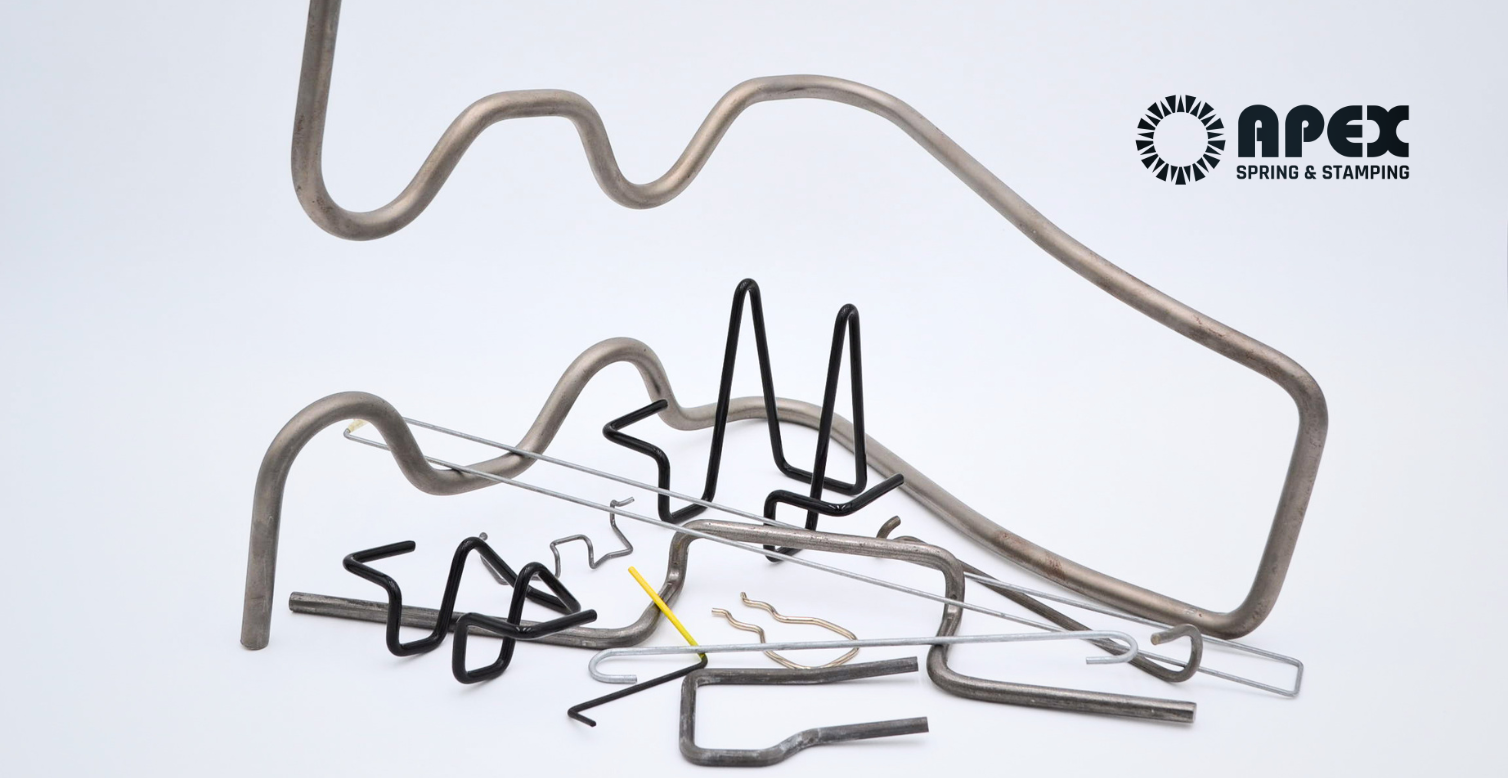
Wire forms are one of the most versatile—and often overlooked—components in modern manufacturing. While they may appear simple, these precisely engineered shapes play a critical role in the performance, safety, and efficiency of countless products.
At Apex Spring & Stamping, wire forms are more than just bent wire—they are engineered solutions designed to meet exact specifications, integrate seamlessly into assemblies, and perform reliably over time. Across industries, custom wire form applications are helping manufacturers simplify designs, reduce costs, and improve product performance in ways that aren’t always obvious at first glance.
What Are Wire Forms, Really?
Wire forms are created by bending and shaping metal wire into highly specific geometries. Unlike springs, which store and release energy, wire forms are typically used for:
- Positioning and alignment
- Retention and fastening
- Guidance and control
- Protection and separation
- Structural support
Because Apex specializes in custom manufacturing, wire forms can be designed to fit precise dimensions, material requirements, and performance expectations—making them ideal for applications where standard parts fall short.
Guiding and Controlling Movement
Many assemblies rely on consistent, controlled movement—but achieving that doesn’t always require complex components. Custom wire forms can guide motion efficiently while reducing part count.
Where You’ll See This
- Sliding mechanisms in equipment and consumer products
- Cable routing and management systems
- Mechanical linkages requiring consistent alignment
At Apex, wire forms are engineered with repeatability in mind, ensuring consistent performance across high-volume production runs. This is especially valuable for OEMs looking to maintain tight tolerances without adding unnecessary complexity.
Securing and Retaining Components
Wire forms are frequently used as clips, retainers, and fasteners—providing secure placement without adding bulk or complicating assembly.
Common Applications
- Clips and retainers in industrial and mechanical assemblies
- Battery contacts and component holders
- Panel and enclosure retention systems
Apex works closely with customers to design wire forms that balance strength, flexibility, and ease of installation. This collaborative approach helps reduce assembly time and ensures long-term reliability in the field.
Protecting Critical Components
In many applications, wire forms serve as protective elements—guarding sensitive components without restricting functionality.
Unexpected Examples
- Guards for fans or moving parts
- Protective barriers within assemblies
- Separation elements to prevent component interference
Because Apex produces wire forms using durable materials and controlled processes, these components are built to withstand demanding environments while maintaining their shape and function.
Supporting Structure Without the Bulk
Wire forms can also provide structural support in a lightweight, cost-effective way. Their ability to distribute loads efficiently makes them a strong alternative to heavier fabricated parts.
Where This Matters
- Fixtures and displays requiring both strength and visual appeal
- Appliance and equipment frameworks
- Material handling and storage components
With Apex’s experience in forming complex geometries, wire forms can often replace multi-part assemblies—reducing welding, fasteners, and secondary operations.
Why Custom Wire Form Applications Matter
Every application has unique requirements—and that’s where custom wire form solutions deliver the most value.
By partnering with Apex early in the design process, manufacturers can:
- Design for manufacturability and cost efficiency
- Reduce part counts and simplify assemblies
- Improve product durability and consistency
- Ensure scalability from prototype to production
Apex Spring & Stamping’s focus on precision manufacturing and customer collaboration ensures that each wire form is designed not just to fit—but to perform.
The Advantage of an Experienced Manufacturing Partner
Wire forms may seem simple, but their performance depends on thoughtful design, material selection, and manufacturing expertise. That’s where working with an experienced partner like Apex makes a difference.
From initial concept to full-scale production, Apex helps customers identify opportunities to:
- Improve efficiency
- Reduce costs
- Enhance product performance
This proactive approach turns a basic component into a strategic advantage.
How Can We Help
As products continue to evolve, the demand for efficient, cost-effective components will only grow. Wire forms offer a unique combination of versatility and simplicity—making them an essential part of modern product design.
If you’re exploring custom wire form applications or looking to optimize an existing component, Apex is ready to help. Early collaboration can uncover opportunities to simplify your design, reduce costs, and improve long-term performance.
| Contact Us | Request A Quote |
Related

Manufacturing
09.10
Your Guide to Spring Material Selection
Your Guide to Spring Material Selection
Successful spring material selection begins with understanding the environment in which the spring will operate and the performance expectations it must meet. While music wire remains a cost-effective solution for many applications, stainless steel excels in corrosive environments, and chrome silicon delivers superior performance in high-stress applications. If you’re unsure which material is right for your application, the engineering team at Apex Spring & Stamping can help identify the best solution for your specific requirements.
Miscellaneous
08.20
FAQs About Custom Spring Quotes
FAQs About Custom Spring Quotes
Whether you have a production-ready drawing, an existing spring that needs to be reverse engineered or an early-stage design that still needs engineering, Apex Spring & Stamping can help you move from concept toward production.

Manufacturing
07.07
Exploring Components in Modern Office Furniture
Exploring Components in Modern Office Furniture
Today’s office furniture market demands products that are durable, aesthetically pleasing, ergonomic, and cost-effective. Achieving those goals requires more than innovative product design—it requires reliable manufacturing partners capable of delivering high-quality components consistently. Apex is proud to have all of this under one roof!