
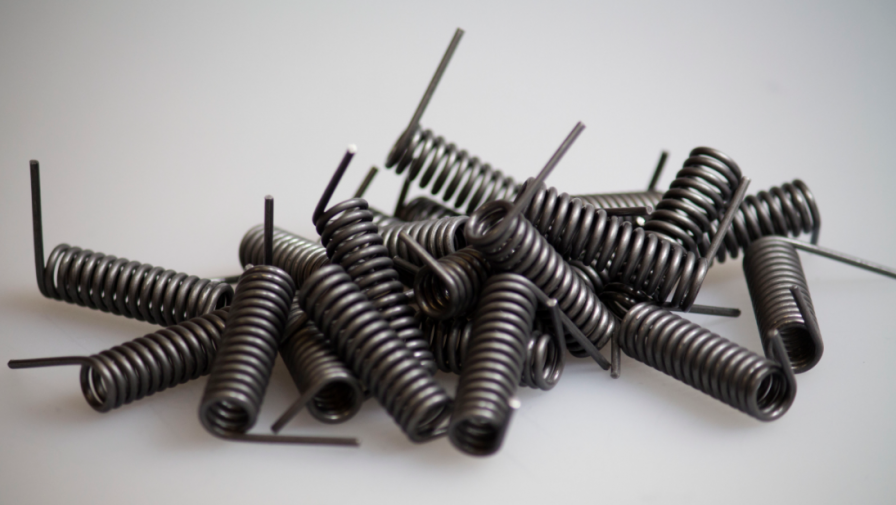
Welcome to the fifth installment of common misconceptions about spring products. Many designers of coil springs just put placeholders in springs data. Read on as we discuss!
Index Design Theory and Definition
There is a direct correlation between wire size and the ID/OD (index) that affects the ability to coil on modern-day equipment. The index of spring is the relationship between the mean coil diameter (MD) and the wire size(WS). The mean wire diameter is the center of the coil body which is:
(MD = OD – WD) or (MD = ID + WD)
The index is the Mean coil diameter (MD) divided by the wire diameter.
For Example:
(Index = MD / WD)
(0.500” (MD) / 0.040” (WD) = Index of 12.5)
- Spring Index: 0 – 3.9: almost impossible to manufacture (ugly)
- Spring Index = 4 – 5: Difficult but not impossible (bad)
- Spring Index = 6-12: Best Range (good)
- Spring Index = 13 – 15: Above Best by not Difficult (a little bad)
- Spring Index = 15 – 25: Difficult (bad)
- Spring Index = > 25: difficult to manufacture (ugly) tolerances are larger
What does this mean in layman’s terms? The index has a direct impact on the ability to hold tolerances on key dimensions in the spring product.
- (ID, OD) on all coil springs (compression, torsion, and extension)
- Free Length on compression springs and extension springs
- Torsion Spring Leg relationships
- Hook relationships on extension springs
This means higher cost, and possibly a situation where the spring can’t be manufactured. Also with difficult and ugly springs, the cost is driven up just by the spring rate, and the ability to hold tolerances. Let Apex Spring and Stamping design and make those calculations work for you. We are experts in spring designs and we can lead you to a better and more cost-effective solution.
How can we help? Contact us today!
| Contact Us | Request A Quote |
Related
Manufacturing
06.04
Exploring Spring Tolerance – PART 2
Exploring Spring Tolerance – PART 2
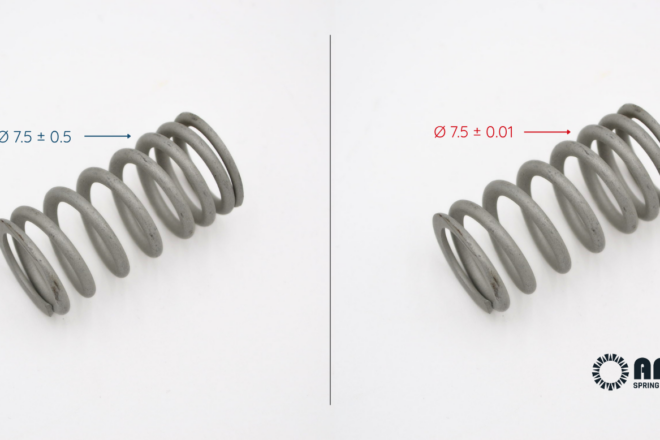
It’s important to consider a realistic tolerance for each part so that all your goals can be accomplished. Considerations like timeframe, budget, product testing, and more. When components perform exactly as expected, everything else works better. Apex understands this and is a perfect partner for your next project!
Manufacturing
05.14
Exploring Spring Tolerances – PART 1
Exploring Spring Tolerances – PART 1
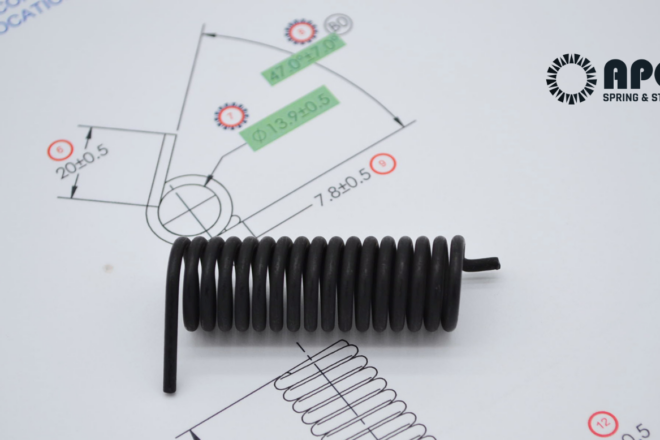
In spring manufacturing, a few thousandths of an inch can truly make all the difference. Tight, consistent tolerances are essential for ensuring performance, reliability, and long-term durability.
Miscellaneous
04.14
The Many Applications for Wire Forms
The Many Applications for Wire Forms
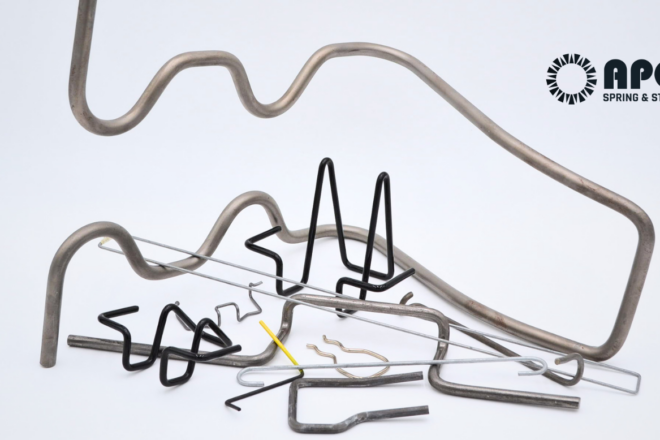
Wire forms are one of the most versatile—and often overlooked—components in modern manufacturing. While they may appear simple, these precisely engineered shapes play a critical role in the performance, safety, and efficiency of countless products.