
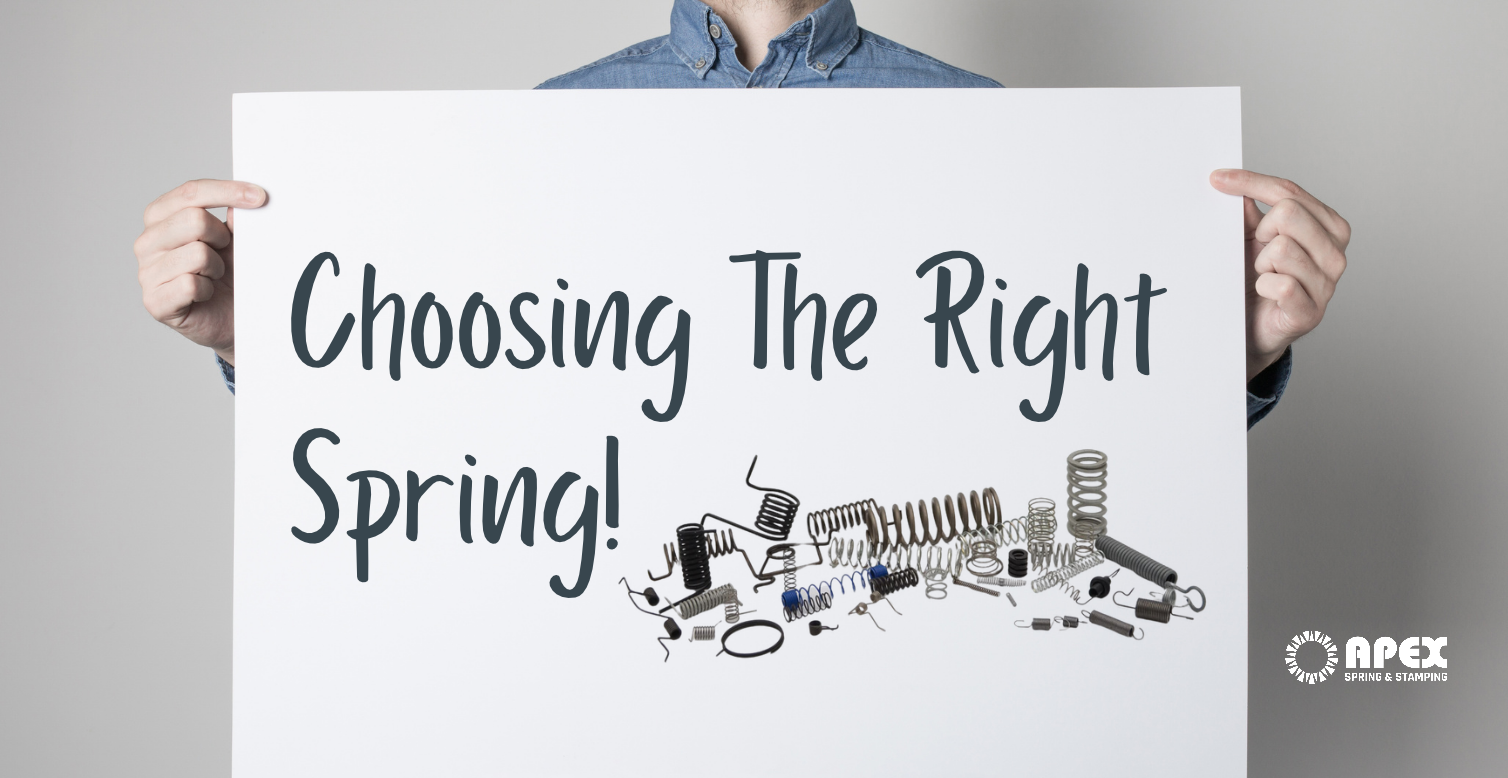
Choosing the right spring starts with understanding how the spring needs to function. Compression springs resist pushing forces; extension springs resist pulling forces, and torsion springs provide rotational force or torque. The best choice depends on your application’s movement, required load, available space, operating environment, and expected cycle life.
At Apex Spring & Stamping, we manufacture custom compression, extension, and torsion springs for a wide variety of industries and applications. Understanding the differences between these spring types is the first step toward selecting a reliable, cost-effective solution.
What Are the Three Main Types of Springs?
The three most common types of mechanical coil springs are compression, extension, and torsion springs. Although each stores and releases mechanical energy, they are designed to respond to different types of movement and force.
| Spring Type | How It Works | Common Applications |
| Compression | Resists being compressed | Valves, switches, suspension mechanisms |
| Extension | Resists being stretched | Latches, return mechanisms, garage doors |
| Torsion | Resists rotational movement | Hinges, clips, counterbalance mechanisms |
Understanding how each spring works can help narrow your options before moving into detailed design.
When Should You Use a Compression Spring?
Choose a compression spring when your application requires a spring to resist a pushing force or return a component after compression.
Compression springs are typically manufactured from coiled wire with space between the coils. When force is applied, the spring compresses and stores energy. As the force is reduced, the spring pushes back toward its original length.
Common applications include:
- Automotive components
- Industrial valves
- Mechanical switches
- Appliances
- Suspension and positioning mechanisms
Important design considerations include wire diameter, spring diameter, free length, spring rate, solid height, and required load.
Learn more in our article on compression spring design considerations and advantages.
When Should You Use an Extension Spring?
Choose an extension spring when your application requires a pulling force to hold components together or return them to their original position.
Extension springs are typically manufactured with tightly wound coils and attachment features, such as hooks or loops, at their ends.
When the spring is stretched, it develops a restoring force that pulls the connected components back toward one another.
Common applications include:
- Door and latch mechanisms
- Agricultural equipment
- Industrial machinery
- Furniture mechanisms
- Mechanical return systems
Extension spring design requires careful consideration of initial tension, maximum extension, attachment geometry, and expected cycle life.
The attachment ends are especially important because they transfer the applied load and can become areas of concentrated stress.
For more information, read An Extended Look at Extension Springs.
When Should You Use a Torsion Spring?
Choose a torsion spring when your application requires rotational force or controlled angular movement.
Unlike compression and extension springs, torsion springs operate through the rotation of their ends. As the spring’s legs rotate relative to one another, the spring develops torque.
Common applications include:
- Hinges
- Clips
- Door mechanisms
- Mechanical linkages
- Counterbalance systems
Important design factors include wire diameter, coil diameter, leg configuration, direction of wind, required torque, and angular travel.
Torsion spring designers must also consider how the spring interacts with surrounding components throughout its operating range. Incorrect clearances or loading direction can contribute to premature failure.
Explore additional information about torsion springs in our spring manufacturing resources.
What Factors Should You Consider When Choosing a Spring?
While spring type is important, successful spring selection involves more than choosing between pushing, pulling, or rotating.
Required Force or Torque
Determine how much force the spring must generate and at what position. Compression and extension springs are commonly specified by force and displacement, while torsion springs are specified by torque and angular displacement.
Available Space
Consider the spring’s operating envelope, including available diameter, length, and travel. A spring must function throughout its movement without interfering with surrounding components.
Material Selection
Material influences strength, fatigue performance, corrosion resistance, and cost.
Apex manufactures springs using materials including music wire, chrome silicon, stainless steel, and pre-coated materials.
Operating Environment
Temperature, moisture, corrosion, and exposure to chemicals can influence spring performance and material selection.
Expected Cycle Life
Springs subjected to repeated loading must be designed to withstand fatigue. Understanding the expected number of operating cycles helps establish appropriate design requirements.
Manufacturing Tolerances
Unnecessarily tight tolerances can increase manufacturing costs, while insufficient control can affect performance.
Apex addresses these considerations in our article Exploring Spring Tolerance – Part 2.
Can a Spring Manufacturer Help You Choose the Right Spring?
Yes. An experienced spring manufacturer can evaluate your application’s force requirements, geometry, material, operating environment, and manufacturing constraints to help determine the appropriate spring design.
At Apex Spring & Stamping, our in-house engineering team provides services including:
- Spring load analysis
- Material recommendations
- Lifecycle testing
- Tolerance and stack-up evaluation
- Design-for-manufacturing analysis
- Stress and failure analysis
- Reverse engineering
Involving our engineering team early in product development can help identify potential performance issues and opportunities to improve manufacturability.
Learn more about our engineering support services.
Why Choose a Custom Spring Instead of a Standard Spring?
Standard springs can work well for applications with common dimensions and performance requirements. However, custom springs are often the better solution when an application requires specific loads, geometries, materials, tolerances, or attachment configurations.
Custom spring manufacturing allows engineers to optimize the component for its intended application rather than modifying the surrounding product to accommodate an off-the-shelf spring.
At Apex, we support projects ranging from prototypes to large production runs, helping customers develop spring solutions that balance performance, quality, and manufacturing cost.
Apex is Here to Help You Choose the Right Spring!
Choosing the right spring is critical to product performance, reliability, and long-term success.
Whether your application requires a compression, extension, or torsion spring—or you’re still determining the best design—Apex Spring & Stamping can help.
Our experienced engineering and manufacturing teams work with customers to evaluate application requirements and develop custom spring solutions.
Let Apex help you find the right spring for your application. Contact us to get started today!
| Contact Us | Request A Quote |
Related

Manufacturing
10.08
5 Questions to Ask Before Choosing a Spring Manufacturer
5 Questions to Ask Before Choosing a Spring Manufacturer
Springs can have a significant impact on product performance, reliability, assembly, and ultimately your customer experience. Therefore, choosing the right manufacturing partner means finding a supplier that understands not only the technical aspects of the product, but also how the spring needs to perform in your application.

Manufacturing
09.10
Your Guide to Spring Material Selection
Your Guide to Spring Material Selection
Successful spring material selection begins with understanding the environment in which the spring will operate and the performance expectations it must meet. While music wire remains a cost-effective solution for many applications, stainless steel excels in corrosive environments, and chrome silicon delivers superior performance in high-stress applications. If you’re unsure which material is right for your application, the engineering team at Apex Spring & Stamping can help identify the best solution for your specific requirements.
Miscellaneous
08.20
FAQs About Custom Spring Quotes
FAQs About Custom Spring Quotes
Whether you have a production-ready drawing, an existing spring that needs to be reverse engineered or an early-stage design that still needs engineering, Apex Spring & Stamping can help you move from concept toward production.