
As with all aspects of industrial products, the materials used to produce wire forms have to be carefully considered when making a selection. They also must be of the highest quality and durable enough to withstand the stress of constant use in their intended application. Many times a wire form is a critical element, and therefore they require the highest quality of metals. The primary types of metals used in wire form manufacturing are steel, aluminum, copper, brass, and nickel. Titanium is used occasionally. Steel is the most common because of its strength, ductility, and conductivity. Lets take a closer look at each of these material and how they are considered for wire forming projects.
Unique Characteristics of Different Metals
Let’s dive into these materials and the characteristics taken into consideration when selections are made for wire form applications.
- Steel – The general term steel covers several different types. They are high carbon, low carbon, and stainless steels. The choice of steel for wire forming is mainly due to its strength, hardness, and resistance to shock. It remains sturdy, rigid, and durable for years and can withstand constant use. The main drawback to steel is its tendency to rust and corrode.
- Aluminum – Aluminum is widely used in the production of wire forms, especially in cases where the product design is more challenging to form. This is because one of the main benefits of aluminum is its ductility, which makes it easily shaped. Aluminum wire is also lightweight and corrosion resistant. These factors increase the number of applications for which it can be used.
- Copper – One of the reasons to use copper in wire forming is its electrical and thermal conductivity, which makes it ideal for electrical applications. It is a strong, flexible, and non-magnetic metal that can be used for applications that involve electricity and high temperatures.
- Brass – Brass is an alloy of copper and a small percentage of zinc. It has all the properties of copper with greater strength. The flexibility and adaptability of brass makes it ideal for wire forming because it can be shaped and formed into an endless number of products. Additional characteristics include corrosion resistance, antibacterial, low friction, conductivity, non-ferromagnetic, and more. All of these can be very useful characteristics for a wire form in certain applications.
- Nickel – Most noteworthy characteristic of nickel is its ability to withstand moist environments and extreme temperatures. While pure nickel is magnetic, its alloys are non-magnetic. Therefore, it is a non-conductive metal that can be placed close to electrical components, which enables nickel to be used close to other parts.
- Titanium – In certain conditions, wire forms are made from titanium, which is the strongest metal in the world. It is ideal for wire forms due to its good elasticity, high melting point, and corrosion resistance. For example, titanium is ideal to produce header bars for aircraft heat exchangers to protect aircraft systems.
Our Experts Are Ready To Help!
Whether you’re considering the right material for your next project or digging deeper into the entire design, we are here and ready to help! Contact us today to get the conversation started!
| Contact Us | Request A Quote |
Related
Miscellaneous
04.14
The Many Applications for Wire Forms
The Many Applications for Wire Forms
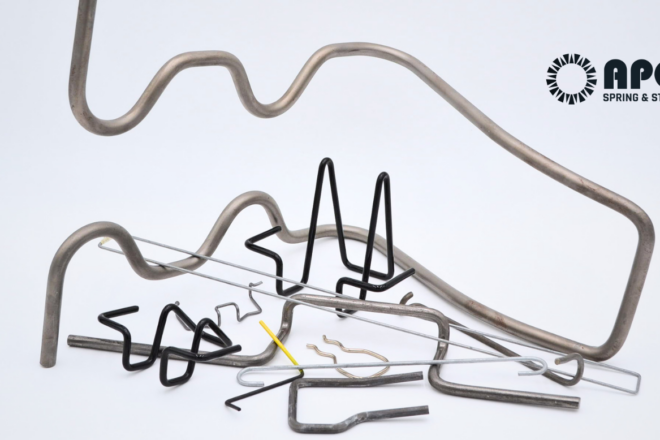
Wire forms are one of the most versatile—and often overlooked—components in modern manufacturing. While they may appear simple, these precisely engineered shapes play a critical role in the performance, safety, and efficiency of countless products.
Manufacturing
03.16
Understanding Four-Slide and Multi-Slide Metal Stamping
Understanding Four-Slide and Multi-Slide Metal Stamping
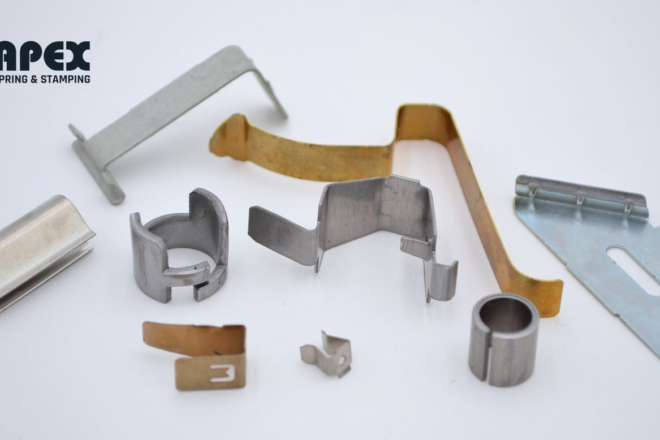
Four-slide and multi-slide metal stamping is widely used for producing complex, precision metal parts, where the material needs to form from multiple directions. These machines are efficient for manufacturing clips, brackets, flat springs, compression limiters, and more.
Assembly
02.12
Apex is Committed to Quality in Assembly
Apex is Committed to Quality in Assembly
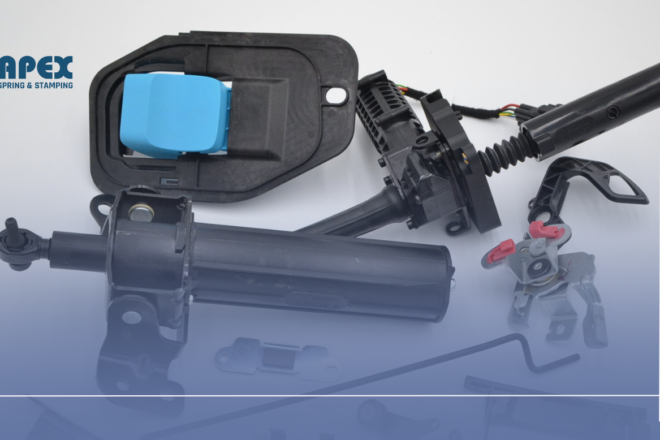
Assembly quality control matters — not just while the parts are at our plant, but for every step in the process thereafter. Apex understands this, and therefore ensures that your assemblies meet the highest standards before they reach the next line, or the end customers.